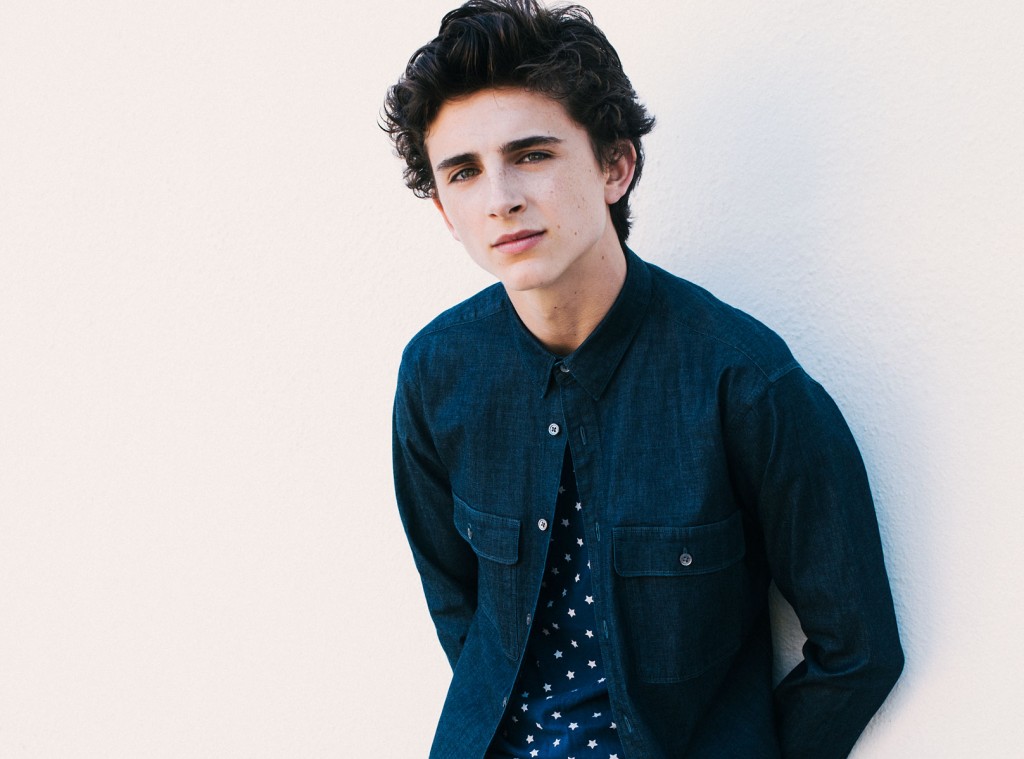
Timothée Chalamet – Takes off in Interstellar
Interview by James Patrick Herman Photographs by Jeff Vespa
You may recognize Timothée Chalamet as the VP’s son on Homeland. Now the native New Yorker is playing Casey Affleck’s younger self in Interstellar. Success may be calling—but Hollywood will have to wait for him to finish college.
Where are you from in New York City?
I was born and raised in Hell’s Kitchen. I lived in Manhattan Plaza, which is the same building where Alicia Keys grew up. Also, Samuel Jackson was a security guard there before he became one of the highest grossing actors of all time.
What’s the most New York thing about you?
Just like with acting, you have to grow up quickly in New York: Taking the subway at 10 at night while getting yelled at by naked, crazy people, for instance. So it helped me with my poise. And it gave me the ability to be calm on set at sixteen: I could go into my own world and not be fazed by everything going on around me.
Are there any true stereotypes of New Yorkers?
We are definitely fast-paced I am always surprised when I’m out west how slow people walk.
You’re also French. What’s the most French thing about you?
Self-deprecation.
What was your big break?
It has to be Homeland.
You were nominated for a SAG Award thanks to that show.
Well, an ensemble SAG Award. But yeah, I get to say that I was. I was seventeen at the time. Not bad.
Meet any acting heroes at the SAG Awards?
I didn’t want to embarrass myself. The only person I talked to was Rainn Wilson. I said: “You were the man on The Office.”
In Christopher Nolan’s new movie, Interstellar, you play the young version of Casey Affleck’s character. And then in the upcoming Adderall Diaries you play the young version of James Franco. What Hollywood actor would you next want to play in his youth?
James Dean. He laid the path for every young actor that followed. He was one of the first actors in pop culture to capture teen angst. And while he wasn’t the one I went to for my own feelings of teenage frustration when I needed to relate to an artist—that would be Kid Cudi—I still appreciate the fact that he laid the groundwork.
Who is your acting hero?
Heath Ledger in The Dark Knight literally inspired me to act. That was the first time I saw a movie and had no clue what was going on in the mind of a character. I loved the unpredictability, the freedom, the looseness with which he played the Joker. He was totally fearless.
Do you feel like you’re fearless?
I don’t. But my greatest lesson in acting is: The more something makes you uncomfortable, the more you should try to tackle it.
You played the sexually ambiguous Emcee in Cabaret while you were a student at the famed Laguardia High School of Music & Art and Performing Arts. That’s daring.
The themes in that musical are a little edgy to say the least. In fact, Ben Brantley, the New York Times critic, talked about our school’s production in his review of the Cabaret revival on Broadway. And I would love to be Hedwig someday. But when I first got to Laguardia, I wasn’t crazy about musical theater. It wasn’t my game plan my entire life to become an actor.
What was your original goal?
To become a soccer player. I am French, after all. Growing up, I split my time between New York and a tiny village about two hours from Léon. In the US, we baby our young kids, but the French culture does not value youth. So soccer was what there was to do.
What dampened your dreams of becoming the next Cristiano Ronaldo?
Reality. I’m not big enough.
You had no interest in becoming a child star even though you did TV commercials as a kid?
That wasn’t acting. It was show business. Because when you are four or five, you’re standing in front of the camera, holding up a brand product and smiling as big as you can. The kids I met on the showbiz circuit when I was young were very scary.
Do you remember the exact moment that shifted your perspective about acting?
My first day in high school changed everything. I learned that I had to dive into my work and do research for my parts. I have my teachers to thank for believing in me. They had faith in me. And eventually I started believing in myself.
I remember interviewing Nicki Minaj, who also went to Laguardia, and she told me that you need to audition in order to get into that school. What inspired you to try out?
My sister went there before me. She would come home telling drama stories. And as a very insecure 12-year-old at the time, Laguardia seemed like a fantastic outlet for all of this energy I had.
Did acting help to build your self-esteem?
I wouldn’t say it helped my insecurity so much as it helped me to come to terms with it. That’s the biggest gift you can learn through through acting: You are flawed. Everyone is flawed. And you can spend your whole life hating yourself because of your flaws—or you can come to accept them and try to make the most of them.
Would you describe yourself as a very sensitive person?
Yeah, I am. That’s the key to my acting. I don’t like to talk about it, but if my mom were here, she would say: “Timmy’s a sensitive boy.”
How did you get cast as the Vice President’s son on Homeland?
It was only supposed to be one episode. Then it turned into two episodes. And then four. And ultimately eight. On the first audition, there was five other guys in the waiting room. On the second audition, it was me and one other guy that I saw in the waiting room. I had a buddy tell me this once and I like it: “You’re not going to get a part because somebody else was better than you. You’re not going to get a part because you weren’t right for it.”
You filmed Interstellar last summer. So after that, why did you decide to go to college instead of going Hollywood?
Balance is important to me. There is a Chinese saying. It’s a curse, actually: “I wish you great success when you are young.” I don’t think being eighteen in Hollywood is a great idea. I would much rather be 22 in New York with an education behind me—and the experiences you get in college that ground you as a person. As an actor, your experiences fuel great work, but it’s also general knowledge. I think it was Stella Adler who said: “The smarter the actor, the smarter the choices.”
Why do you interpret that Chinese saying is a curse: Because so many child stars end up in rehab?
You can lose perspective on what accomplishment means or—even worse—start feeling like that type of pressure is normal.
Your Homeland costar, Claire Danes, once took a break from acting to attend Yale. Did she advise you to put your education first?
Claire said: “You can get your education whenever you want in life, but there is something to be said for doing it at eighteen. And having those experiences young. They are formative experiences.” So I would rather tackle show business at 22. My physical body isn’t even completely mature yet.
How old were you when you landed an agent?
Fifteen.
Before you even had a driver’s license. How did you do it?
I was freelancing with an agency at the time, and they would send me out on auditions. Then I did a play called The Talls at Second Stage Theater Company in New York. After doing that play, I felt like: “OK, I can hang with the pros now. It’s time to put the pedal to the metal.” The agency wanted to sign me, and I asked to be sent out for more stuff. From there I did four episodes of Royal Pains.
How would you describe your character in The Talls?
A sexually curious twelve-year-old. I was the youngest member of this tall family, and I had the smallest part in the play. But what was great about not having many lines but being on stage for a long time is it gave me a lot of room to play. I was projecting. I had a character. I had an internal life going on. I had all of that stuff. And it worked. I was acting! I got good feedback but more importantly, I had the best time of my life. From that point, I realized: This is fun. And this is cool. This isn’t fake bullshit. Or at least this doesn’t have to be fake bullshit. This can be a real thing; this is a craft.
So how was your freshman year in college?
It was difficult going from performing arts school into an intense academic environment, which is Columbia. I was surrounded by insanely driven people.
What’s the best part about college life?
Independence. I am someone who is turned on by independence, maybe almost too much. It was the first time I left home. Initially I lived in the dorms but then left halfway through the year. I was like: What am I doing here when I have a nice big bed at home—and good food and wonderful loving parents? Now I just moved off campus with roommates: Washington Heights. Watch out world, here I come!
Do you have any hidden talents?
I can hip-hop dance pretty well. People don’t expect me to bust out the Dougie.
Did you ever have a real job?
I was a coach at a soccer camp in France. I coached six to ten-year-olds when I was around thirteen. I was good at it, but the pay was not acting money. I definitely see more teaching in my future. I would not be sitting in this seat if it wasn’t for my teachers. That’s the most magical thing on the planet: To have such a profound affect on the lives of kids in the classroom. If I could do that, it would be a dream.